Nikunj Patel
at
Nikunj Patel
at

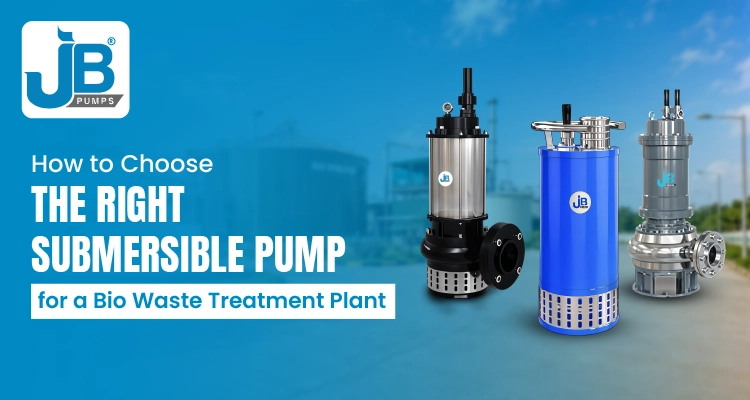
Choosing the wrong pump for a bio waste treatment plant does not just cause operational headaches. It leads to costly downtime, premature equipment failure, environmental compliance issues, and unplanned maintenance cycles that eat into your margins. Whether you are designing a new effluent treatment plant (ETP), upgrading an existing sewage treatment plant (STP), or managing a large-scale industrial bio waste system, the pump you select sits at the heart of everything.
The good news is that this decision becomes much simpler when you know exactly what to look for. From flow rate and solid handling capacity to material construction and motor protection ratings, every specification matters in a bio waste environment.
JB Pumps has helped hundreds of industrial clients across India and international markets select the right submersible pump for bio waste and wastewater treatment applications. This guide walks you through every critical factor, so you can make a confident, informed decision.
Key Takeaways
- Pump Type Matters: Bio waste treatment plants typically require submersible sewage pumps, sludge pumps, or slurry pumps depending on the composition and viscosity of the waste stream.
- Solid Handling Capacity Is Critical: Choose a pump rated to handle the maximum solids size in your waste stream. Bio waste often contains fibrous material, grit, and semi-solid sludge.
- Material of Construction Determines Lifespan: Corrosive bio waste demands pumps built from cast iron, SS-304, SS-316, or high-chrome alloy to prevent rapid wear.
- Motor Protection Rating Must Match the Environment: Look for IP-68 rated motors with Class F insulation for continuous submersible operation in aggressive bio waste conditions.
- Flow Rate and Head Calculations Are Non-Negotiable: Undersized pumps cannot clear waste efficiently; oversized pumps waste energy and cause system stress. Always calculate your exact requirements.
- Energy Efficiency Reduces Operating Costs: A pump running 24/7 in a treatment plant has a massive impact on your electricity bill. Selecting the right motor size and efficiency class pays for itself quickly.
- Maintenance Accessibility Affects Total Cost of Ownership: Pumps with easy-access mechanical seals, auto-coupling systems, and guide rail installations reduce service time significantly in STP and ETP settings.
- One Pump Rarely Fits All Zones: Large bio waste treatment plants often need different pump types for raw intake, sludge thickening, effluent transfer, and dewatering. Plan each zone separately.
What Is a Bio Waste Treatment Plant and Why Does Pump Selection Matter So Much?
A bio waste treatment plant is a facility that processes organic and biological waste from industrial, municipal, or agricultural sources. This includes food processing effluent, municipal sewage, animal waste, pharmaceutical discharge, paper and pulp effluent, and agro-industrial wastewater.
The waste streams in these plants are rarely simple. They can contain:
- High concentrations of suspended solids and organic matter
- Fibrous materials like rags, plant fibers, and food residue
- Abrasive grit and inorganic particles
- Corrosive chemicals and pH-sensitive fluids
- Thick, viscous sludge that forms during biological treatment stages
A standard centrifugal pump cannot handle these conditions. It will clog, corrode, overheat, or fail within weeks. A purpose-built submersible pump for bio waste treatment, correctly specified, can run reliably for years.
Ready to find the right pump for your treatment plant?
Visit jbpumpsindia.com to explore the full range of industrial submersible pumps built for bio waste and effluent applications.
What Are the Different Stages of a Bio Waste Treatment Plant That Need Pumps?
Before selecting any pump, you need to map your treatment plant layout and identify exactly where pumping is required. Each stage has its own fluid characteristics and demands a different pump specification.
Stage 1: Raw Waste Intake / Inlet Pumping: This is where untreated bio waste enters the system. The fluid is at its most aggressive, often containing large solids, fibrous material, and grit. A heavy-duty submersible sewage pump with non-clog impeller design is the standard choice here.
Stage 2: Equalization and Aeration Tanks: These tanks require continuous circulation or mixing to prevent settlement and maintain biological activity. Submersible mixers or agitator pumps are used alongside sewage pumps at this stage.
Stage 3: Primary and Secondary Treatment: Settled sludge at the bottom of clarifiers needs to be transferred for further processing. Submersible sludge pumps handle the thick, viscous material that accumulates in these zones.
Stage 4: Sludge Thickening and Dewatering: As sludge is concentrated before disposal or further treatment, the fluid becomes extremely dense. High-pressure sludge pumps or slurry pumps are typically used here.
Stage 5: Effluent Transfer and Discharge: Treated water may need to be pumped to discharge points, storage tanks, or reuse systems. Submersible dewatering pumps work well at this clean-water or near-clean-water final stage.

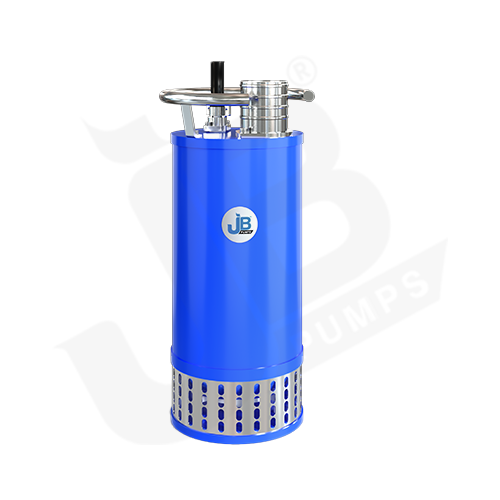
What Type of Submersible Pump Is Best for Bio Waste Treatment?
There is no single correct answer. The best submersible pump for a bio waste treatment plant depends on which stage of treatment you are addressing and what the fluid characteristics are. Here is a breakdown of the most commonly used pump types:
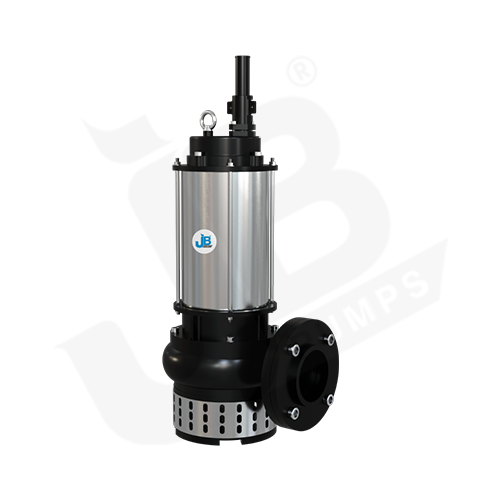
Submersible Sewage Pumps
These are the workhorses of any bio waste or wastewater treatment plant. Designed specifically to handle raw sewage, industrial effluent, and waste liquids containing solids, they use vortex or semi-open impellers to pass solid matter without blocking.
JB Pumps submersible sewage pumps are built with non-clog technology capable of handling solids up to approximately 50mm in diameter, making them ideal for raw intake and primary collection sumps in bio waste plants.
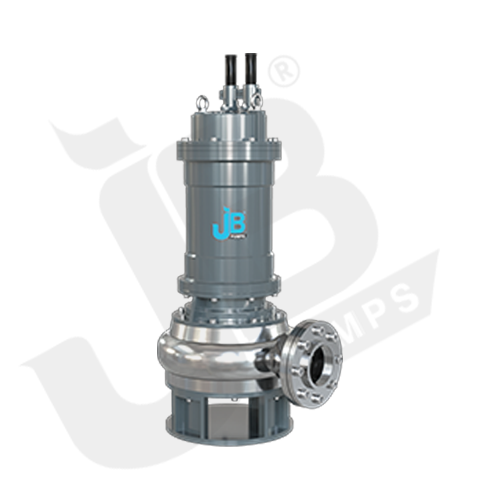
Submersible Sludge Pumps
When the fluid is thick, sticky, and heavily laden with solids, a standard sewage pump is not enough. Submersible sludge pumps are specifically designed for high-viscosity fluid handling. They use robust impeller designs and wider flow passages to move semi-solid bio waste efficiently without excessive wear.
JB Pumps submersible sludge pumps are widely deployed in ETP and STP facilities, handling biological sludge, industrial wastewater tanks, and sludge thickening applications.
Submersible Slurry Pumps
For bio waste streams that also contain abrasive particles (common in food processing, pharmaceutical, or agro-industrial effluent), submersible slurry pumps offer better wear resistance. These are built with hardened materials like high-chrome alloy to withstand abrasive contact over extended operating cycles.
Submersible Dewatering Pumps
At the final effluent transfer or dewatering stage, where the fluid is largely treated and relatively clear, submersible dewatering pumps provide high flow at lower head, moving large volumes efficiently and at lower operating cost.
Not sure which pump type fits your plant layout?
Our experts at JB Pumps can assess your treatment stages and recommend the right product for each zone.
How Do You Calculate the Right Pump Size for a Bio Waste Plant?
Pump sizing is the most technically critical step in the selection process. Getting it wrong in either direction creates problems.
Undersized pumps cannot keep up with incoming waste volume, leading to overflow, system backup, and regulatory non-compliance. Oversized pumps cost more to run, create excessive turbulence, and destabilize biological treatment processes.
Here are the key parameters you must calculate before specifying any pump:
Flow Rate (Q): Measured in liters per second (LPS) or cubic meters per hour (m³/hr). This is the volume of bio waste that must be transferred per unit of time. For treatment of plants, this is based on average daily flow and peak surge volumes.
Total Dynamic Head (TDH): The total pressure the pump must generate, expressed in meters. This includes static head (vertical lift), friction losses in piping, and velocity head. For bio waste plants, pipe material and diameter also affect friction significantly.
Specific Gravity and Viscosity: Bio waste and sludge are denser and more viscous than clean water. Standard pump curves are based on water. Always derate performance for higher specific gravity fluids.
Solids Content and Size: Expressed as a percentage of suspended solids (% SS). Higher solids content requires wider impeller clearances and more robust motor protection.
NPSH (Net Positive Suction Head): Verify that the available NPSH at the pump installation point exceeds the required NPSH for your chosen pump model. Submersible pumps naturally have excellent NPSH performance due to their submerged installation.
Pump Selection Comparison Table: Which Pump for Which Stage?
Treatment Stage | Fluid Characteristics | Recommended Pump Type | Key Requirement |
Raw Intake / Inlet Sump | Large solids, fibrous, high variability | Submersible Sewage Pump | Non-clog impeller, solids passage up to 50mm |
Equalization Tank | Mixed sewage, moderate solids | Submersible Sewage Pump + Mixer | Continuous duty, mixing capability |
Primary Clarifier Sludge | Thick sludge, moderate viscosity | Submersible Sludge Pump | High torque, wide flow passage |
Secondary Sludge | Activated sludge, high organic content | Submersible Sludge Pump | Corrosion resistance, smooth flow |
Sludge Thickening | Dense, viscous, abrasive | Submersible Slurry Pump | High-chrome or SS construction |
Effluent / Dewatering | Treated water, low solids | Submersible Dewatering Pump | High flow, energy efficiency |
Sludge Recirculation | Variable solids, continuous operation | Submersible Sludge Pump | Auto-coupling, guide rail system |
What Material of Construction Should You Specify for Bio Waste Pumps?
Material selection is one of the most overlooked aspects of pump specification in bio waste applications. The wrong material causes corrosion, premature wear, and contamination of treated effluent.
Here is how to match your fluid chemistry to the right construction material:
- Cast Iron: The standard choice for municipal sewage and general bio waste with neutral pH. Cost-effective, durable, and widely available. Suitable for most domestic sewage and food processing wastewater applications.
- Stainless Steel SS-304: Better corrosion resistance than cast iron. Suitable for bio waste with mild acid or alkali content, food-grade effluent, and pharmaceutical wastewater where hygiene is a concern.
- Stainless Steel SS-316 / SS-316L: Required when the bio waste contains chlorides, seawater influence, or moderately aggressive chemicals. Common in marine-adjacent facilities, chemical industry ETP plants, and pharmaceutical discharge systems.
- High-Chrome Alloy: The choice for abrasive bio waste slurries. Offers exceptional wear resistance when solids are hard, angular, or present in high concentrations. Standard in mining-adjacent bio waste streams or industrial wastewater with abrasive particulates.
Explore JB Pumps full range of material options across our submersible sewage, sludge, and slurry pump ranges at jbpumpsindia.com and get specifications matched to your effluent chemistry.
What Motor and Electrical Specifications Matter Most for Bio Waste Treatment Pumps?
The motor is just as important as the pump’s hydraulic end. In a bio waste treatment plant, motors operate continuously in submersed, aggressive, and often confined conditions. Here are the critical specifications to evaluate:
- IP Rating: Always specify IP-68 rated motors for submersible applications in bio waste. IP-68 means the motor is fully protected against continuous immersion at defined depths. Anything lowers the risk of motor failure from fluid ingress.
- Insulation Class: Class F insulation is the industry standard for continuous duty submersible motors in wastewater applications. It handles temperatures up to 155°C, providing a meaningful thermal safety margin even in warm bio waste conditions.
- Motor Power Range: For bio waste treatment plants, pump motor requirements typically range from 2 HP for small collection sumps to over 100 HP for large-scale industrial ETP systems. Matching motor size accurately to duty point is essential for energy efficiency.
- Single Phase vs Three Phase: Smaller installations may use single-phase power. Industrial bio waste treatment plants almost universally run on three-phase power for reliability and reduced starting current.
- Thermal Overload Protection: Built-in thermal sensors in the motor winding detect overheating and trigger automatic shutdown before damage occurs. This is a non-negotiable feature for continuous duty applications.
- Soft Starters and Variable Frequency Drives (VFDs): For applications where flow demand varies (common in bio waste plants with batch loading), VFDs allow the pump speed to be varied, dramatically reducing energy consumption and mechanical stress.
What Are the Key Differences Between Pump Types for Bio Waste Applications?
Feature | Sewage Pump | Sludge Pump | Slurry Pump | Dewatering Pump |
Solids Handling | Up to ~50mm solids | High-viscosity semi-solids | Abrasive particulates | Low solids, clean water |
Impeller Type | Vortex / Semi-open | Single or double channel | Hardened, wide clearance | Closed or semi-open |
Material Options | Cast iron, SS | Cast iron, SS-304/316 | High-chrome alloy, SS | Cast iron, SS |
Typical Head Range | Moderate | Moderate to High | Moderate to High | Low to Moderate |
Typical Applications | Inlet sumps, collection | Sludge transfer, ETP/STP | Abrasive bio slurry | Effluent transfer, drainage |
Motor IP Rating | IP-68 | IP-68 | IP-68 | IP-65 to IP-68 |
Maintenance Interval | Medium | Medium to High | High (wear parts) | Low |
What Installation Features Should You Look for in a Bio Waste Plant Pump?
The best pump specification is only valuable if it is installed correctly and accessibly. In a bio waste treatment plant, installation practicalities significantly affect lifecycle cost and maintenance downtime.
- Auto-Coupling and Guide Rail Systems: These allow the pump to be lifted out of a wet pit for maintenance without anyone entering the confined space. This is not just a convenience feature. It is a safety requirement in most industrial and municipal environments. JB Pumps designs its submersible sewage and sludge pumps to be compatible with standard auto-coupling guide rail systems.
- Dry-Run Protection: Bio waste levels in collection sumps can fluctuate rapidly. A pump running dry without fluid lubrication for the mechanical seal will fail quickly. Specify pumps with float switch controls or dry-run protection sensors.
- Submersible Mixer Integration: In equalization, tanks and aeration basins, submersible mixers are often installed alongside pumps to maintain fluid homogeneity and prevent sludge settlement. Coordinate pump and mixer placement during plant design.
- Cable Management and Penetration Sealing: In bio waste environments, cable gland and penetration integrity are critical. Bio waste gases can be corrosive to electrical components. Specify sealed cable entries rated for the environment.
Planning a new bio waste treatment plant or upgrading existing pump installations?
Speak with our team for application-specific installation guidance.
How Does Energy Efficiency Factor into Bio Waste Pump Selection?
A submersible pump running continuously in a bio waste treatment plant consumes a significant amount of energy over its operational lifetime. Energy costs can far exceed the initial capital cost of the pump over a five-to-ten-year period.
Here is how to evaluate energy efficiency during pump selection:
Pump Efficiency Curve: Every pump has a Best Efficiency Point (BEP) on its performance curve. Operating close to the BEP minimizes energy waste and reduces mechanical wear. Select a pump whose BEP aligns with your actual operating duty point.
Motor Efficiency Class: IE3 and IE4 premium efficiency motors use meaningfully less electricity than IE1 or IE2 equivalents at the same output. For continuous duty bio waste applications, the additional upfront cost of a premium motor pays back quickly.
VFD Compatibility: Variable speed operation via a VFD is the single biggest lever available for reducing pump energy consumption in applications with variable flow demand. Bio waste treatment plants often have significant diurnal flow variation, making VFD control highly beneficial.
System Resistance Curve Matching: Many energy efficiency problems stem not from the pump itself but from the pipe system design. Ensure that pipe diameters, bends, and valve types are designed to minimize friction losses.
According to the International Energy Agency, electric motors (including those driving pumps) account for approximately 45% of global electricity consumption, with industrial pumping systems representing a major portion of that total. Optimizing pump selection and control in bio waste plants is one of the most impactful energy reduction steps available to plant operators.
What Maintenance Practices Extend the Life of Bio Waste Treatment Pumps?
Even the best pump specification will fail prematurely without proper maintenance. Here are the most important practices for bio waste plant pump longevity:
- Regular Mechanical Seal Inspection: Mechanical seals are the primary wear component in submersible pumps operating in bio waste. Inspect seal condition during every planned maintenance interval. Oil leakage from the seal chamber is the first warning sign.
- Impeller Clearance Checks: Wear in the impeller clearance leads to reduced performance and increased power consumption. Check and adjust impeller clearance at regular intervals, especially for sludge and slurry pumps in high-abrasion service.
- Motor Winding Insulation Testing: Conduct insulation resistance (IR) testing on motor windings at planned maintenance intervals. Degrading insulation in a bio waste environment is an early indicator of impending motor failure.
- Bearing Replacement: Replace bearings on schedule based on operating hours rather than waiting for failure. Bearing failure in a submersible pump typically damages the motor winding and seal simultaneously, turning a low-cost bearing replacement into a major repair.
- Strainer and Volute Inspection: Periodically inspect pump inlet strainers and volute casings for buildup of fibrous material, scale, or biological growth that can restrict flow.
- Spare Pump Availability: For critical bio waste treatment applications, always maintain a standby pump in the installed wet pit or as a portable backup. Renting a backup pump through a rental pump program is a cost-effective approach for facilities that cannot justify a second installed unit.
What Are the Most Common Mistakes When Selecting a Pump for Bio Waste Treatment?
Buying purely on price is the most expensive mistake a plant operator can make. A cheap pump that fails in six months costs far more than a correctly specified, higher-quality unit with a five-year service life.
Other common errors include:
- Specifying a pump based on clean-water curves without adjusting for bio waste specific gravity and viscosity
- Selecting a motor that is either too large (wastes energy) or too small (trips overload protection and shortens lifespan)
- Ignoring IP rating and purchasing pumps rated only for intermittent immersion in a continuous submersible application
- Failing to account for peak surge flows during storm events or batch loading
- Not specifying corrosion-resistant materials for bio waste streams with fluctuating pH
Working with an experienced industrial pump manufacturer who understands bio waste treatment hydraulics from the start eliminates most of these risks. JB Pumps has served wastewater treatment, municipal STP, industrial ETP, and bio waste management clients across India and international markets, and our team brings deep application knowledge to every pump selection.
Don’t let a poor pump choice cost your plant tens of thousands in downtime and repairs.
Connect with our team at JB Pumps today and let us help you get the specification right from the beginning.
Conclusion: The Right Pump Is a Long-Term Investment, Not Just a Purchase
Selecting the right submersible pump for a bio waste treatment plant is a decision that shapes your plant’s reliability, operational cost, and environmental compliance for years to come. There is no one-size-fits-all answer. The right pump depends on your specific waste stream, treatment stage, flow requirements, and installation environment.
What remains constant is the need for pumps built to industrial standards, with the correct material construction, motor protection rating, and hydraulic design for bio waste service. Cutting corners on pump specification is the fastest route to unplanned downtime and rising maintenance costs.
JB Pumps is one of India’s leading industrial submersible pump manufacturers, with a proven range of submersible sewage pumps, sludge pumps, slurry pumps, dewatering pumps, and submersible mixers designed for the most demanding bio waste and wastewater treatment applications. We serve clients across construction, municipal infrastructure, chemical processing, food processing, pharmaceutical, agro-industrial, and EPC sectors.
If you are planning a new bio waste treatment plant, upgrading existing pump systems, or troubleshooting performance issues with your current setup, our team is ready to help. Reach out to our experts at jbpumpsindia.com, and let us help you select the right pump for every stage of your treatment process.
Frequently Asked Questions (FAQs)
1. What type of submersible pump is best for a bio waste treatment plant?
The best type depends on the treatment stage. Submersible sewage pumps handle raw bio waste intake. Submersible sludge pumps are used for thick biological sludge transfer. Slurry pumps are chosen when the waste stream contains abrasive particles. Dewatering pumps handle treated effluent at the final discharge stage.
2. What flow rate should I specify for a bio waste treatment pump?
Calculate your average daily flow and peak surge flow in cubic meters per hour (m³/hr). Your pump must be sized to handle peak flow without running continuously at full capacity. Always add a 20-25% safety margin above your calculated peak to account for variability in bio waste generation.
3. What IP rating should a submersible pump have for bio waste applications?
Specify IP-68 rated motors for all continuously submerged applications in bio waste treatment plants. IP-68 guarantees protection against continuous immersion at defined depths. Lower ratings like IP-65 are only appropriate for splash-protection scenarios, not continuous submersion.
4. What materials are best for bio waste submersible pumps?
Cast iron is suitable for neutral-pH bio waste. Stainless steel SS-304 or SS-316 is required for mildly corrosive effluent or food-grade applications. High-chrome alloy is the choice for abrasive bio slurries. Select material based on the pH range, chloride content, and abrasivity of your specific waste stream.
5. How do I prevent a bio waste pump from clogging?
Select a pump with a non-clog impeller design or a vortex impeller sized to pass the largest solids present in your waste stream. Install inlet screens where appropriate but ensure screen mesh size does not introduce hydraulic losses. Regular maintenance and periodic volute inspection prevent fibrous material buildup.
6. How often should submersible pumps in a bio waste plant be serviced?
Service intervals depend on duty severity. Mechanical seals and impeller clearances should be checked every 1,000 to 2,000 operating hours in continuous duty bio waste service. Motor insulation resistance testing should be conducted annually. Bearings should be replaced on a schedule based on manufacturer recommendations and operating hours.
7. Can I use the same pump for multiple stages of a bio waste treatment plant?
Technically possible in very small plants but not recommended for medium or large facilities. Each treatment stage has distinct fluid characteristics requiring specific impeller design, material construction, and motor sizing. Using one pump type across all stages leads to either underperformance or premature wear.
8. What is the difference between a sludge pump and a sewage pump for bio waste treatment?
A sewage pump handles raw wastewater with large solid particles and fibrous content, using non-clog impeller technology. A sludge pump is designed for thicker, high-viscosity, semi-solid material that forms during biological treatment stages. Sludge pumps have wider flow passages and more robust impeller designs than sewage pumps to handle dense, sticky material without clogging.