Nikunj Patel
at
Nikunj Patel
at

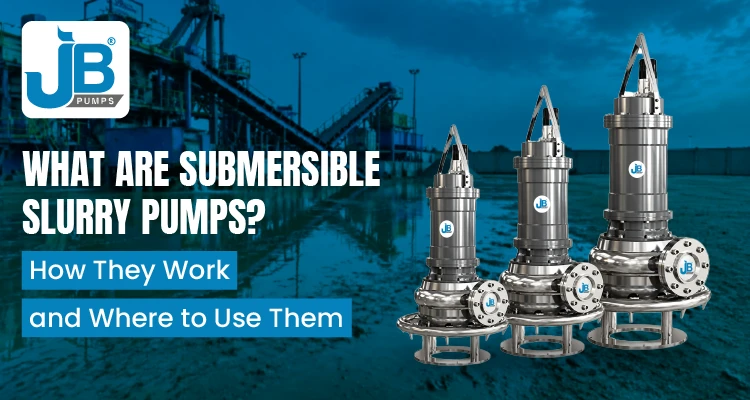
Submersible slurry pumps are heavy-duty industrial pumps designed to operate fully submerged in abrasive, thick, and solid-laden fluids. Unlike standard water pumps, these machines are built to handle mixtures of liquid and solid particles, including sand, gravel, clay, coal, tailings, and industrial sludge.
If your operation involves moving anything thicker than clean water, a submersible slurry pump is almost certainly part of the equation. From deep mine pits and construction sites to wastewater treatment plants and oil fields, these pumps keep critical processes moving safely and efficiently.
JB Pumps manufactures submersible slurry pumps built specifically for demanding industrial environments. Our range is engineered to deliver consistent performance even under the most punishing operating conditions.
Key Takeaways
- Definition: A submersible slurry pump is a fully submerged pump that moves abrasive, solid-laden fluid mixtures through a discharge pipe.
- Working principle: The pump uses a rotating impeller to convert motor energy into centrifugal force, pushing slurry upward through the discharge.
- Material advantage: High-chrome alloy or rubber-lined wet parts resist abrasion and extend pump service life significantly.
- Primary applications: Mining, construction dewatering, wastewater treatment, dredging, sand extraction, and steel and cement plants.
- Slurry vs. sewage pump: Slurry pumps handle abrasive solids and thick slurries; sewage pumps are designed for softer organic waste and lighter suspensions.
- Selection factors: Particle size, solid concentration, flow rate, head requirement, and fluid pH all influence the right pump choice.
- Submersible advantage: Running submerged eliminates priming issues, reduces noise, saves surface space, and improves heat dissipation.
- Maintenance priority: Regular impeller inspection, mechanical seal checks, and bearing lubrication are critical to maximizing pump life.
What Is a Submersible Slurry Pump?
A submersible slurry pump is a centrifugal pump with a sealed motor unit that operates while fully immersed in the fluid being pumped. It is purpose-built to move high-density mixtures containing abrasive particles, suspended solids, and viscous sludge.
The key difference from a regular submersible pump is construction. Slurry pumps use hardened wear-resistant components, reinforced sealing systems, and specially designed impellers that can pass large solid particles without clogging or damaging the internals.
These pumps are also called electric submersible slurry pumps, solid handling submersible pumps, or abrasive slurry handling pumps depending on the application context.
How Does a Submersible Slurry Pump Work?
The working principle of a submersible slurry pump follows standard centrifugal mechanics, adapted for high-wear conditions.
Here is the step-by-step process:
- Motor activation: The sealed electric motor powers a rotating shaft inside the pump casing.
- Impeller rotation: The shaft drives the impeller at high speed, generating centrifugal force within the pump volute.
- Suction inlet: The spinning impeller creates a low-pressure zone at the inlet, drawing slurry into the pump from the surrounding medium.
- Centrifugal discharge: The rotating impeller flings the slurry outward against the casing walls, increasing its velocity and pressure.
- Discharge pipe exit: The pressurized slurry exits through the discharge pipe, transported to the required destination.
The impeller design is critical here. Submersible slurry pumps use agitator-type or vortex impellers that can handle particles up to 50mm or larger. This prevents blockages and allows continuous pumping of thick, gritty mixtures that would destroy a standard pump within hours.
Looking for a slurry pump that handles your specific solid particle size and flow rate? Explore JB Pumps‘ submersible slurry pump range and get specifications matched to your application.
What Is Slurry in the Context of Pumping?
Slurry is a semi-liquid mixture of solid material suspended in water or another liquid. In industrial pumping, slurry is classified by its solid concentration (percentage by weight or volume) and particle characteristics including size, hardness, and shape.
Common types of slurry encountered across industries include:
- Mining slurry: Crushed rock, coal fines, or ore particles suspended in water
- Industrial sludge: Thick byproduct waste from manufacturing or processing plants
- Cement slurry: Fine cement particles mixed with water during construction
- Dredge slurry: Sand, clay, and sediment suspended in water at riverbeds or seabeds
- Tailings slurry: Residue from mineral processing plants
Understanding slurry composition directly affects which pump design and material you need. High-abrasion slurries demand high-chrome alloy components. Corrosive slurries need rubber-lined or stainless-steel wet parts.
What Are the Main Types of Submersible Slurry Pumps?
The right pump type depends on your industry, slurry characteristics, and installation depth.
Comparison Table 1: Types of Submersible Slurry Pumps
Pump Type | Best For | Solid Handling | Typical Application |
Agitator Slurry Pump | Settled or compacted slurry | Up to 50mm+ | Mining pits, sand ponds |
Vortex Impeller Pump | Fibrous or stringy solids | Medium solids | Wastewater, paper mills |
High-Chrome Alloy Pump | Highly abrasive slurry | Large, sharp particles | Quarrying, dredging |
Rubber-Lined Pump | Mildly abrasive, corrosive | Medium particles | Chemical plants, ETP |
Heavy-Duty Motor Pump | High head requirements | All sizes | Deep mine dewatering |
Choosing the wrong type results in accelerated wear, frequent downtime, and costly part replacements. If you are handling slurry pump issues and performance problems in your current setup, the pump type may be the root cause.
Submersible Slurry Pump vs. Other Pump Types: What Is the Difference?
Many buyers confuse slurry pumps with sewage pumps or sludge pumps. They are not interchangeable.
Many buyers confuse slurry pumps with sewage pumps or sludge pumps. They are not interchangeable.
Comparison Table 2: Submersible Slurry Pump vs. Sewage Pump vs. Sludge Pump
Feature | Slurry Pump | Sewage Pump | Sludge Pump |
Fluid handled | Abrasive solids + water | Soft organic waste | Thick biological sludge |
Solid particle size | Up to 50mm+ | Up to 80mm (soft) | Medium to large |
Impeller type | Agitator / vortex | Non-clog vortex | Vortex / open impeller |
Wear resistance | Very high (chrome/rubber) | Moderate | High |
Typical installation | Submerged in pit/tank | Wet well, sump | STP, ETP, lagoon |
Industries | Mining, construction, dredging | Municipal sewage, buildings | Wastewater treatment |
The key distinction is abrasion tolerance. A sewage pump will fail quickly when exposed to sharp rock particles or coarse sand. Similarly, a slurry pump is not optimized for handling the fibrous organic content found in municipal sewage systems.
For a deeper look at how these pump types compare across different wastewater applications, the comparison guide covering sewage vs. sludge vs. dewatering pumps is worth reading before making a purchase decision.
Not sure whether you need a slurry pump, sludge pump, or dewatering pump for your project? Connect with our experts at JB Pumps and get a clear recommendation based on your actual fluid conditions.
Where Are Submersible Slurry Pumps Used?
Submersible slurry pumps serve a wide range of industries where conventional pumps cannot survive.
1. Mining and Quarrying
Mining operations generate enormous volumes of slurry from ore processing, pit dewatering, and tailings management. Submersible slurry pumps handle the continuous movement of high-density mineral slurries from processing circuits to tailings of storage facilities.
They are also deployed in underground mine dewatering, where abrasive groundwater mixed with rock fines must be removed quickly to maintain safe working conditions. JB Pumps has built a strong track record in mining slurry pump solutions for demanding global markets.
2. Construction and Infrastructure Projects
Large construction sites produce slurry during foundation drilling, pile boring, and tunneling. Submersible slurry pumps remove this mixed waste from excavation pits before it can compromise structural integrity or delay work schedules.
These pumps are also used for dewatering flooded trenches and basements where sediment-laden water would quickly wear out a standard dewatering pump.
3. Wastewater Treatment Plants
Municipal and industrial wastewater treatment plants use slurry pumps to transfer activated sludge, grit chamber waste, and primary settlement tank underflows. The high solids content and abrasive grit particles demand pumps with superior wear resistance.
4. Dredging and Sand Extraction
River dredging, harbor maintenance, and sand mining operations require continuous pumping of dense, sandy slurry from the waterbed to barges or stockpile areas. Submersible slurry pumps with built-in agitators are standard equipment for these applications.
5. Steel and Cement Plants
Scale pits in steel plants accumulate a mixture of mill scale, water, and grit that must be regularly pumped out. Cement plants generate fine particle slurries during production. Both environments demand high-chrome alloy pumps to withstand the abrasive nature of the materials.
6. Oil and Gas Industry
Drilling fluid management, mud handling, and produced water treatment in oil and gas facilities all involve solid-laden fluids. Electric submersible slurry pumps provide reliable performance in these technically demanding environments.
Running a mine, plant, or construction site that requires continuous slurry removal? See how JB Pumps‘ heavy-duty submersible slurry pumps are built for your industry.
What Are the Benefits of Using a Submersible Slurry Pump?
The submersible design offers meaningful advantages over surface-mounted or horizontal slurry pumps in many applications.
Self-priming free operation: Because the pump operates fully submerged, there is no need for priming equipment or vacuum systems. The pump starts immediately without air lock issues.
Space efficiency: Submersible units eliminate the need for above-ground pump houses, suction pipes, and priming systems. This is a major advantage of confined construction sites or underground mine installations.
Reduced noise and vibration: Submersion in liquid naturally dampens pump noise, making these units significantly quieter than surface-mounted alternatives in noise-sensitive environments.
Thermal protection: The surrounding fluid continuously cools the motor casing, reducing overheating risk during long continuous operating cycles.
Portability: Most submersible slurry pumps can be repositioned quickly using a crane or cable, making them suitable for applications where the fluid level or pit location changes frequently.
Versatile installation: These pumps can operate in sumps, pits, tanks, riverbeds, and flooded excavations with equal effectiveness.
How to Choose the Right Submersible Slurry Pump
Pump selection errors are expensive. Over-specifying wastes capital. Under-specifying causes premature failure. Use these five parameters to guide your selection.
1. Particle size and shape: Identify the maximum solid particle size in your slurry. Angular, sharp particles cause more wear than rounded ones. This determines impeller clearance and material selection.
2. Solids concentration: Measure the percentage of solids by weight or volume. High concentrations above 30-40% by weight require larger bore pumps with higher torque motors.
3. Required flow rate and head: Calculate the volume of slurry that must be moved per hour and the total vertical height and pipe friction losses it must overcome. These define the pump’s hydraulic duty point.
4. Fluid chemistry: Check for corrosive elements such as acidic or alkaline pH, sulfur compounds, or chlorides. Corrosive slurries need rubber-lined or stainless-steel components rather than standard chrome alloy.
5. Continuous vs. intermittent duty: Continuous operations demand higher-grade motors, better sealing systems, and more robust bearing assemblies than intermittent use applications.
Have your slurry data ready but unsure which pump model fits? Share your application details with our team at JB Pumps and we will recommend the right specification.
How to Maintain a Submersible Slurry Pump
Maintenance is the single biggest factor in pump longevity. A well-maintained slurry pump operating in a mining application can deliver 8,000 to 10,000+ hours before major overhaul. A neglected one may fail within 500 hours.
Key maintenance practices include:
- Impeller inspection: Check for wear, pitting, or erosion every 500 to 1,000 operating hours depending on slurry abrasively.
- Mechanical seal check: The mechanical seal prevents slurry from entering the motor cavity. Any loss of seal integrity causes rapid motor failure.
- Bearing lubrication: Inspect and re-grease bearings at scheduled intervals. Bearing failure is one of the most common causes of pump downtime.
- Wear plate monitoring: The suction side wear plate has a heavy impact on solid particles. Monitor thickness and replace before breakthrough.
- Cable and connector inspection: Check submersible power cables for cuts, abrasion, or moisture ingress at every service interval.
- Motor winding resistance test: Test insulation resistance periodically to detect moisture contamination before motor burnout occurs.
Following the manufacturer’s maintenance schedule is the most effective way to protect your investment. For a more detailed breakdown of pump servicing practices, the submersible mud pump maintenance guide from JB Pumps covers practical service procedures worth bookmarking.
Conclusion
Submersible slurry pumps are one of the most technically demanding pump categories in industrial use. Getting the selection right, the installation corrects, and the maintenance consistent makes the difference between a long-serving asset and a costly recurring problem.
For plant managers, procurement teams, and project engineers sourcing pumps for abrasive slurry applications, understanding the working principle, material construction, and application boundaries covered in this guide gives you the foundation to make confident, well-informed decisions.
JB Pumps designs and manufactures submersible slurry pumps built to perform in mining, construction, dredging, wastewater, and industrial processing environments. Our pumps are engineered for high wear resistance, long service intervals, and reliable performance in the toughest conditions. If you are specifying slurry handling equipment for an upcoming project or replacing underperforming units in an existing plant, our team is ready to help. Reach out to our experts at JB Pumps and let us help you find the right pump for the job.
Frequently Asked Questions
1. What is a submersible slurry pump used for?
A submersible slurry pump is used to move thick, abrasive mixtures of liquids and solid particles. Common applications include mining dewatering, construction of pit drainage, dredging, wastewater sludge transfer, and sand extraction. It operates while fully submerged in the fluid being pumped.
2. What is the difference between a slurry pump and a sewage pump?
A slurry pump is designed to handle abrasive, mineral-based solids suspended in water, such as sand, gravel, or coal fines. A sewage pump handles softer organic waste in municipal or building drainage systems. Using a sewage pump in a slurry application causes rapid wear and early failure.
3. How does a submersible slurry pump work?
The pump uses a sealed electric motor to spin a hardened impeller inside a volute casing. This creates a centrifugal force that draws slurry through the inlet and pushes it up through the discharge pipe. An agitator at the base helps break up settled solids before they enter the pump.
4. What is the maximum particle sizing a slurry pump can handle?
This depends on the specific pump model and impeller design. Most industrial submersible slurry pumps handle particles from 25mm to 50mm. Heavy-duty models with wide-clearance impellers can handle larger solid particles depending on the volute bore size.
5. Are submersible slurry pumps suitable for corrosive fluids?
Yes, when fitted with the correct wet-end materials. Mildly corrosive slurries can be handled by rubber-lined versions. For highly acidic or alkaline environments, stainless steel or specialty alloy components are required. Always specify fluid pH and chemistry when ordering.
6. How long does a submersible slurry pump last?
Service life depends on slurry abrasively, operating hours, and maintenance of quality. In well-maintained mining applications with moderate abrasion, 8,000 to 12,000 operating hours before major overhaul is achievable. Highly abrasive conditions may require impeller and wear plate replacement much sooner.
7. Can submersible slurry pumps run dry?
No. Running dry, even briefly, will overheat the motor and destroy the mechanical seal. These pumps must remain submerged during operation. Dry-run protection sensors are available and should be specified for automated or unmanned installations.
8. What is the difference between a slurry pump and a sludge pump?
Slurry pumps are built primarily for inorganic abrasive particles in mining and construction environments. Sludge pumps are optimized for thick biological sludge in wastewater treatment applications. Both require wear-resistant construction, but the impeller designs and material choices differ based on fluid composition.