Nikunj Patel
at
Nikunj Patel
at

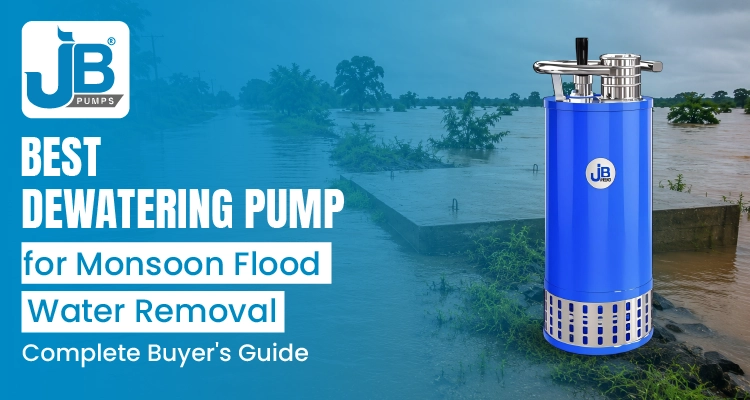
Every monsoon season, the same crisis plays out across construction sites, industrial plants, and municipal drainage zones: floodwater rises faster than standard drainage systems can handle it, halting operations and causing significant damage within hours. The difference between a flooded site shutting down for weeks and one that recovers within hours often comes down to a single piece of equipment a properly selected dewatering pump.
Whether you are managing a waterlogged excavation pit, a flooded factory floor, or a storm-overwhelmed municipal zone, this guide covers everything you need to choose the best dewatering pump for monsoon flood water removal. From pump types and capacity sizing to common deployment mistakes and seasonal maintenance, you will leave with a clear, practical decision framework. Companies like JB Pumps have built their entire industrial dewatering range specifically around these high-stakes, high-volume monsoon conditions.
Key Takeaways
- Best pump type for monsoon: Submersible dewatering pumps are the top choice for flood water removal during monsoon because they operate fully submerged without requiring manual priming, enabling fast deployment when time is critical.
- Flow rate must exceed site inflow: The pump you select must remove water faster than it accumulates. An undersized pump actively prolongs the flood scenario rather than resolving it.
- Solids handling is non-negotiable: Monsoon floodwater carries silt, sand, and debris. Any pump selected must be rated for solids handling to prevent clogging and impeller damage.
- Portable pumps offer deployment flexibility: Portable submersible dewatering pumps can be repositioned across a site as flood conditions shift, making them more practical than fixed units for most active monsoon events.
- Rental reduces cost for seasonal use: For monsoon events lasting one to three months per year, renting a high-capacity industrial dewatering pump is significantly more cost-effective than purchasing.
- Motor protection is a baseline requirement: IP68-rated motor enclosures and thermal overload protection are minimum specifications for any pump operating in flood conditions.
- Pre-season inspection prevents failure: Pumps stored through the dry season often have degraded seals and corroded impellers. A proper inspection and test run before monsoon arrives prevents failures at the worst possible time.
- Site type determines pump configuration: Construction excavations, industrial floors, and municipal drains each require different pump configurations. A single-solution approach will leave at least one scenario underserved.
Getting your dewatering setup right before monsoon arrives is far easier than fixing it mid-flood. Explore the full range of industrial pumping solutions at jbpumpsindia.com and see what fits your site’s requirements.
What Is a Dewatering Pump and Why Does Monsoon Make It Essential?
A dewatering pump is designed to remove accumulated water from places where it should not be: construction excavations, basements, industrial plant floors, tunnels, and open flooded areas. Unlike standard water transfer pumps, dewatering pumps are built to handle dirty, debris-laden water at high continuous flow rates under demanding conditions.
During peak monsoon events across India and South Asia, rainfall intensity frequently exceeds 100 mm per hour. Standard drainage infrastructure cannot manage that volume, especially when runoff from multiple directions concentrates in one location. A properly sized dewatering pump closes the gap between unmanaged flooding and a controlled drainage operation.
How Monsoon Flooding Affects Different Site Types
Construction sites face rapid inundation of foundation pits, which weakens excavated soil, delays concrete pours, and risks structural destabilization. Industrial facilities face electrical hazards, machinery corrosion, and complete production shutdowns. Municipal drainage zones experience urban waterlogging that disrupts roads, utilities, and public health infrastructure.
In every one of these environments, water accumulates faster than conventional drainage can handle. That is where a dedicated flood water removal pump becomes the deciding factor.
What Are the Different Types of Dewatering Pumps for Flood Water Removal?
Not all dewatering pumps perform equally in monsoon flood conditions. Each type has specific operational strengths, and choosing the wrong one produces inadequate performance, high maintenance costs, and premature failure.
Submersible Dewatering Pumps
Submersible dewatering pumps operate fully submerged in the water they are removing. This eliminates priming time entirely and allows the pump to begin working within minutes of being lowered into the flooded area. Their motors are sealed inside IP68-rated housings that protect against full, sustained immersion.
These pumps are available across a wide capacity range, from compact portable units for small-scale dewatering to heavy-duty industrial models designed for high-sediment, high-volume conditions. JB Pumps submersible dewatering pumps are engineered specifically for the debris-laden floodwater that monsoon events produce, making them a dependable choice for rapid field deployment.
Self-Priming Mud Pumps
Self-priming mud pumps are the right choice when the pump cannot be positioned directly inside the flooded area. They draw water from a distance without any manual priming, which makes them suitable for sites where submerging the pump unit presents a practical or safety difficulty.
These pumps also perform well when floodwater carries heavier solids such as clay, gravel, or construction material fragments. Active excavation sites during heavy monsoon rainfall frequently produce this type of mixed-load floodwater.
Rental Pumps for Seasonal Flood Events
For businesses that need high-capacity dewatering for one to three months per year during the monsoon season, purchasing a large pump outright may not be financially practical. JB Pumps’ industrial rental pump options give operations access to heavy-duty dewatering capacity only when the season demands it, without committing capital to equipment that stays idle for eight or nine months a year.
Not sure whether buying or renting a dewatering pump is the right call for your operation this season?
Our team at JB Pumps can walk you through the most cost-effective option based on your site’s flood risk profile.
Connect With UsHow Do You Choose the Best Dewatering Pump for Monsoon Conditions?
Choosing the right pump is not about selecting the highest-capacity model available. It is about matching specifications to your site’s exact conditions. Four key factors drive that decision.
Flow Rate and Head Pressure: What Numbers Matter?
Flow rate is the volume of water a pump can move per unit of time, measured in liters per minute (LPM) or cubic meters per hour (m3/h). For monsoon flood water removal, the pump rated flow must exceed the rate at which water enters the site. If site inflow outpaces pump output, the water level continues to rise despite the pump running at full capacity.
To estimate your site’s inflow rate, multiply your catchment area (in square meters) by the peak rainfall intensity (in meters per hour). Then add a 20 to 30% safety buffer to that figure when selecting the pump’s rated flow capacity.
Head pressure refers to the vertical height the pump must push water against to reach the discharge point. A pump removing water from a 5-meter excavation to ground-level discharge needs adequate rated head to maintain full flow across that lift. Always check both flow rate and total dynamic head (TDH) when comparing options.
Solid Handling Capacity: Why It Is Critical in Flood Scenarios
Monsoon floodwater is almost never clean. It carries silt, sand, organic debris, and sometimes larger solid fragments depending on site activity. A pump without adequate solid handling capability will clog within hours, requiring continuous manual intervention.
For general flood water removal, look for a pump rated to handle solids up to at least 20 to 30 mm in diameter. Sites near active excavation, mining, or heavy construction activity will need higher solid passage ratings still.
Portability vs. Fixed Installation
Portable submersible dewatering pumps can be repositioned as flood conditions shift across a site during an active monsoon event. This matters when a large site has multiple flood ingress points that change over time.
Fixed installation pumps offer higher sustained flow rates and make sense for permanent dewatering stations in facilities that flood predictably every monsoon season.
Power Source and Site Safety
Most industrial dewatering pumps are electric-driven. In flood conditions, confirming that power supply is protected, properly grounded, and safely routed is critical before startup. For remote sites or locations where grid power becomes unreliable during heavy storms, diesel-driven pump configurations keep the operation running.
Which Pump Configuration Fits Each Monsoon Scenario?
Scenario | Recommended Pump Type | Priority Specification |
Construction excavation pit | Submersible dewatering pump | High flow rate + solid handling |
Urban waterlogging / storm drain overflow | Heavy-duty submersible dewatering pump | High head + continuous duty rating |
Industrial plant floor flooding | Portable submersible dewatering pump | Fast deployment + compact form factor |
Mining site accumulation | Submersible slurry pump | Abrasion resistance + solids capacity |
Seasonal or temporary deployment | Rental dewatering pump | Cost-effectiveness + ready availability |
Remote site without reliable grid power | Diesel-driven self-priming pump | Fuel autonomy + high flow rate |
Construction Sites and Foundation Pits
Construction sites carry some of the highest flood risk during monsoon due to open excavations and exposed unstable soil. Submersible dewatering pumps in the 500 to 2,000 LPM range are typically the right starting point for construction industry dewatering needs, scaled to the depth and catchment area of the specific excavation.
Municipal and Urban Waterlogging
Municipal waterlogging requires pumps that can sustain continuous operation for 24 to 72 hours or longer without overheating or performance loss. Cooling-jacket motor designs and automatic float switches are important features in this context, as they prevent the two most common causes of pump failure in sustained flood applications.
Industrial Facilities and Plant Floors
Plant floor flooding creates immediate electrical hazards and machinery corrosion risk, making fast response critical. Portable submersible dewatering pumps deployed at the low points of a facility can clear even large floor areas within a few hours, limiting production downtime and protecting installed equipment from extended water contact.
If your site needs a pump that can handle both the volume and the debris load of monsoon flooding without stopping, our team at JB Pumps is ready to specify the right solution. Get in touch with our experts here.
What Pump Capacity Do You Need for Different Flood Volumes?
Matching pump capacity to actual site conditions prevents underperformance without overspending on unnecessary excess capacity. Use this table as a practical starting reference when scoping your requirements.
Flooded Area / Volume | Estimated Inflow Rate | Recommended Pump Capacity | Suggested Pump Type |
Small site or basement (up to 200 m2) | 200 to 500 LPM | 300 to 600 LPM rated | Portable submersible dewatering pump |
Medium construction pit (200 to 500 m2) | 500 to 1,500 LPM | 1,000 to 2,000 LPM rated | Heavy-duty submersible dewatering pump |
Large industrial facility (500 to 2,000 m2) | 1,500 to 5,000 LPM | 3,000 to 6,000 LPM combined | Multiple submersible dewatering pumps in parallel |
Municipal zone or large open area | 5,000+ LPM | 10,000+ LPM combined | High-capacity submersible + rental pump backup |
Mining site or open pit | Variable with high solids | Site-specific calculation required | Submersible slurry pump |
These are practical reference figures, not final engineering specifications. A complete pump sizing exercise should account for your site’s exact geometry, local rainfall intensity data, and soil permeability before you finalize any procurement.
What Are the Most Common Dewatering Mistakes Made During Monsoon?
Even a well-specified pump will fail early or underperform if deployed incorrectly. These are the most frequent site-level errors that produce avoidable problems during active monsoon events.
Running the pump dry: When water levels drop below the pump intake, the motor draws air, overheats, and can seize permanently. A float switch that automatically shuts down the pump before dry running occurs prevents this entirely.
Under sizing the discharge line: Pairing a high-capacity pump with a narrow discharge hose creates back pressure that dramatically reduces effective flow output. The discharge pipe diameter must match the pump’s rated outlet size.
Ignoring the solids handling rating: A pump rated for clean water will suffer rapid impeller damage when run through silt-laden monsoon floodwater. Always confirm the solids specification before deployment, not after the first clog.
Skipping the pre-season inspection: Pumps stored through the dry season frequently develop seized seals, degraded cable insulation, and corroded impeller passages. Running a full inspection and test cycle before monsoon starts is a straightforward step that eliminates a major source of in-season failures.
Using non-rated electrical accessories: All extension cables, junction boxes, and protective devices used in flood environments must carry outdoor and wet-rated certifications. This is a basic electrical safety requirement that is frequently skipped under time pressure on active sites.
Avoid avoidable failures this monsoon season. Our team at JB Pumps can review your current pump setup and recommend the right configuration before the rains arrive. Reach our experts here.
How Do You Maintain a Dewatering Pump During and After Monsoon Season?
Consistent, structured maintenance is what separates pumps that run reliably for years from those that fail at the start of their second monsoon season. A practical schedule works across three windows.
During active monsoon use (check weekly):
- Inspect discharge hose connections and joints for leaks
- Check power cable for surface wear or abrasion damage
- Verify the float switch activates and deactivates correctly
- Monitor motor temperature where accessible via the control panel
After each major flood event:
- Flush the pump with clean water to clear internal sediment
- Inspect and clean the impeller housing
- Check the mechanical seal for wear indicators
- Confirm all external fasteners are tight and showing no early corrosion
Post-monsoon before seasonal storage:
- Run clean water through the pump for 15 to 20 minutes to clear residual sediment
- Dry the motor housing thoroughly before placing in storage
- Lubricate any grease points per manufacturer specifications
- Store in a dry, covered location off the ground and away from moisture
Good maintenance hygiene before and after the season is what ensures your dewatering equipment is ready when the next major rain event arrives.
Conclusion
Choosing the best dewatering pump for monsoon flood water removal requires matching pump specifications to your site’s exact conditions, not selecting the most powerful model in a catalog. Submersible dewatering pumps remain the most versatile and dependable solution for the majority of monsoon scenarios, from construction pit drainage and industrial floor flooding to municipal waterlogging events. Self-priming mud pumps fill the gap when site access is restricted, and rental pumps keep the cost equation practical for seasonal requirements.
JB Pumps manufactures heavy-duty submersible dewatering pumps built specifically for the high-sediment, high-volume conditions that monsoon flooding creates. With extensive experience serving construction, industrial, and municipal clients across India and internationally, our team is ready to help you identify the right pump configuration for your site before the season demands it. Reach out to our team at JB Pumps and make sure your dewatering setup is ready before the monsoon arrives.
Frequently Asked Questions
1. What is the best type of dewatering pump for monsoon flood water removal?
Submersible dewatering pumps are the most effective choice for monsoon applications. They operate fully submerged, require no priming, and reliably handle debris-laden floodwater over extended periods. Both portable and heavy-duty configurations are available to match different site volumes and access conditions.
2. How do I calculate the right pump capacity for a flooded site?
Multiply your site’s catchment area (in square meters) by the peak rainfall intensity (in meters per hour) to estimate the water inflow rate. Select a pump rated at least 20 to 30% above that inflow figure so the water level actively drops during operation. Also calculate the total vertical lift required to determine the necessary head pressure rating.
3. Can a standard water pump handle monsoon floodwater?
No. Standard water pumps are not designed for the silt, debris, and solid content typical of monsoon floodwater. Running one through flood conditions causes rapid impeller damage, frequent clogging, and motor failure within a short time. Always use a pump with a solid handling specification appropriate to the site.
4. What motor protection rating should a monsoon dewatering pump have?
IP68 is the minimum recommended motor protection rating for pumps operating in flood conditions, as it certifies sustained full immersion protection. Thermal overload protection is equally important for preventing motor burnout during continuous extended operation.
5. Should I buy or rent a dewatering pump for monsoon use?
If your site faces annual monsoon flooding and requires pump coverage for three or more months per year, purchasing typically offers better long-term value. For single-season projects, short-term deployments, or emergency backup capacity, renting gives access to industrial-grade equipment without the capital expenditure.
6. How long can a submersible dewatering pump run continuously?
A continuous-duty rated industrial submersible dewatering pump can run for 24 hours or longer provided it has adequate motor cooling from the surrounding water, a functioning float switch to prevent dry running, and clean, properly rated cable connections maintained throughout the operating period.
7. How do I prevent my dewatering pump from clogging during monsoon?
Select a pump with a solids handling rating matched to your site’s specific flood water content. Position the intake away from areas with the highest debris concentration. Use an inlet strainer where available, and operate the pump continuously rather than in short cycles that allow sediment to accumulate around the intake during idle periods.
8. What is the difference between a dewatering pump and a sewage pump?
A dewatering pump is designed to move large volumes of mildly contaminated or sediment-laden water rapidly. A sewage pump is built to continuously transfer wastewater with high organic solid content. For monsoon flood water removal in construction, industrial, and municipal settings, a dewatering pump is the correct choice unless the site also has direct sewage contamination present.