Nikunj Patel
at
Nikunj Patel
at

Modern wastewater management is an invisible giant. When it works, society functions. When it fails, the results are immediate, costly, and hazardous. The single most common point of failure? Clogging.
This is where non-clog sewage submersible pumps shift from being a component to being the foundation of operational reliability.
For plant engineers, maintenance managers, and EPC contractors, a pump clog isn't just an inconvenience; it's a full-stop emergency. It means downtime, manual intervention in hazardous conditions, and the risk of major overflows. At JB Pumps, we understand that your system's reliability is only as strong as its weakest link.
This post explores exactly why non-clog technology isn't just an upgrade - it's an essential requirement for any serious wastewater, industrial, or municipal system.
What Is a Non-Clog Sewage Submersible Pump?
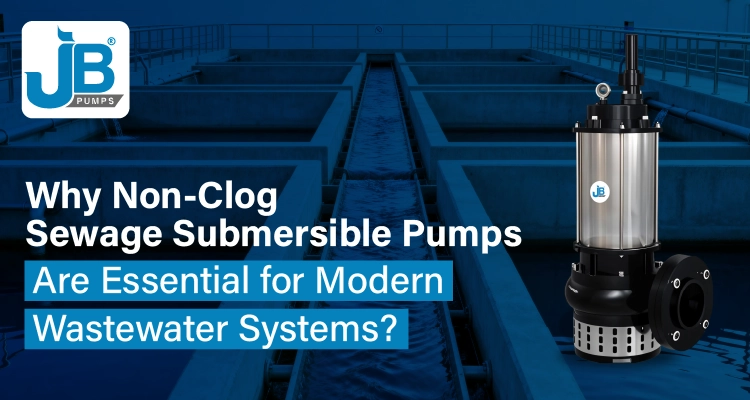
A non-clog sewage submersible pump is a specialized pump engineered to operate fully submerged in wastewater. Its defining feature is its design, which allows it to handle and pass large solids, fibrous materials (like rags and wipes), and other debris without jamming or clogging.
Unlike standard dewatering pumps, which move relatively clean water, a non-clog pump features a uniquely designed impeller and a wide-open casing (volute). This design prioritizes passing solids over achieving maximum hydraulic efficiency, ensuring continuous flow even in the toughest conditions.
The Core Problem: Why Do Traditional Pumps Fail in Wastewater?
Traditional pumps or those not specifically designed for "solids-handling" fail because they are built with tight limits. Their impellers are designed to move water, not the debris in the water.
When faced with raw sewage, industrial effluent, or sludge, these pumps quickly encounter problems:
- Fibrous Materials: Rags, wipes, and sanitary products wrap around the impeller shaft, creating a "ragging" effect that chokes the pump.
- Large Solids: Unexpected debris clogs the inlet or jams the impeller, causing it to stop or, worse, burn out the motor.
- Abrasive Slurries: Grit, sand, and other abrasives in the flow wear down standard impellers, leading to rapid performance degradation and failure.
Each failure demands manual, time-consuming, and often dangerous maintenance, driving up labor costs and increasing risk for your team.
How Does Solids-Handling Pump Technology Prevent Clogging?
The "magic" of a non-clog pump starts with its hydraulic design. Instead of forcing water through narrow channels, it creates an open path for both water and the solids within it.
There are several key designs that accomplish this:
- Vortex Impellers: This impeller is recessed within the pump casing. It creates a powerful whirlpool, or "vortex," in the water. This vortex, not the impeller itself, does most of the work, pulling the water and solids through the pump with minimal contact. This is exceptionally effective for stringy materials and large, irregular solids.
- Single-Channel Impellers: These feature a large, open passage that allows solids to pass through directly. They are highly efficient at moving large volumes of water that contain solids and are a robust choice for municipal sewage.
- Wide-Passage Volutes: The pump casing (the volute) is designed to be wider or wider than the impeller's passages. This ensures that any solid that can pass through the impeller can also exit the pump without getting stuck.
This focus on passing solids rather than just moving water is the fundamental difference that ensures operational reliability.
What Are the Main Benefits of Non-Clog Pumps?
For procurement managers and plant engineers, the decision to invest in non-clog technology is justified by a powerful return on investment. The benefits go far beyond just "not clogging."
1. Drastically Reduced Downtime and Maintenance?
Yes. This is the most significant benefit. A non-clog pump, like our JBSP Series Submersible Sewage Pumps, is designed to handle the "worst-case scenario" of raw sewage 24/7. This means your maintenance team spends less time pulling pumps and more time on preventative, high-value tasks. Fewer clogs mean fewer emergency callouts and less operational downtime.
2. A Lower Total Cost of Ownership (TCO)?
absolutely. While a specialized non-clog pump may have a higher initial purchase price than a standard pump, its TCO is significantly lower.
Think about the costs of a clog:
- Labor: Cost of sending a 2-person maintenance crew.
- Equipment: Cost of a crane or truck to lift the pump.
- Downtime: Cost of the plant or processing offline.
- Repairs: Cost of replacing burnt-out motors or broken impellers.
A non-clog pump covers all these expenses, paying itself quickly through uninterrupted operation.
3. Increased Operational Reliability and Peace of Mind?
Yes. In municipal lift stations or critical industrial processes, a pump failure can lead to environmental spills, regulatory fines, and production halts. Non-clog submersible pumps provide a "set it and forget it" level of reliability. This peace of mind is invaluable for managers responsible for 24/7 operations.
4. Versatility in Handling Tough Materials?
Non-clog pumps are not just for sewage. Their durable design makes them ideal for a range of difficult applications. This versatility means a similar design philosophy can be applied to other challenging fluids.
- For heavy sludge: Submersible Sludge Pumps are used.
- For abrasive slurries: Our JBSL Series Submersible Slurry Pumps or JBHCSL Series Horizontal Centrifugal Slurry Pumps use hardened materials and non-clog principles to handle abrasive particles in mining or dredging.
- For thick mud: Our JBSM Series Self-Priming Mud Pumps can handle the high-viscosity, solid-laden fluid found in construction and mining.
5. Improved Plant Safety and Hygiene?
Fewer manual interventions mean less frequent exposure for your maintenance crews. Every time a pump is pulled from a wet well, the team is exposed to raw sewage and the associated biological hazards. By installing a reliable non-clog pump, you are directly investing in the long-term health and safety of your staff.
What Industries Depend on Non-Clog Wastewater Pumps?
The need to move high in solid water is common across many heavy industries. The technology is critical for:
- Municipal Wastewater Treatment: The backbone of lift stations, headworks, and clarification processes. They move raw, unscreened sewage from homes and businesses to the treatment plant.
- Construction & Infrastructure: On-site dewatering where water is mixed with soil, sand, and debris. Our JBDPT Series Submersible Dewatering Pumps are often the first line of defense, but non-clog pumps are needed when the debris level is high.
- Mining & Minerals: Pumping abrasive slurries from tailing ponds or moving water from my sumps. Reliability here is key to keeping the entire processing operation running.
- Industrial Effluent: Plants in food processing, pulp and paper, and chemical manufacturing produce wastewater with high solid content, byproducts, and "sticky" materials that instantly clog standard pumps.
What Should You Consider When Selecting a Sewage Pump?
Choosing the right non-clog pump is more complex than just matching the pipe size. As an EPC contractor or procurement manager, getting this right is critical for the project's long-term success.
Always consider these factors:
1.Nature of the Solids: What is in the water? Is it soft solids (sewage), fibrous materials (rags), abrasive grit (sand/slurry), or large, irregular debris? This determines the type of impeller (e.g., vortex vs. channel).
2.Flow Rate (GPM or m³/h): How much fluid do you need to move in each time?
3.Total Dynamic Head (TDH): How high and how far do you need to pump the fluid? This includes vertical lift (static head) and friction loss in the pipes.
4.Liquid Characteristics: Is the fluid corrosive (pH level)? What is the temperature? Is it viscous (like thick sludge)? This will determine the pump materials of construction (e.g., cast iron, stainless steel).
5.Motor and Installation: Does it require an explosion-proof motor? Will it be a wet-pit (submerged) installation on a guide rail system?
Don't just "buy a pump." Consult with a pump engineer. The team at JB Pumps can analyze your application and effluent to select a pump that perfectly matches your specific operational needs, ensuring long life and reliability.
The Clear Solution for Complete Flow
The challenge of modern wastewater is handling more complex solids—from "flushable" wipes to industrial byproducts—than ever before. A non-clog sewage submersible pump is no longer a specialty item; it is the new standard.
Investing in the right solid handling technology is a direct investment in your plant's uptime, your team's safety, and your operational budget. By preventing the single most common point of failure, you ensure the entire system can function as designed.
At JB Pumps, we don't just sell pumps; we deliver reliable, long-term flow solutions. Our portfolio, from the JBSP Series Sewage Pumps to the powerful JBSL Slurry Pumps, is designed to handle the toughest jobs your industry can throw at.
Ready to end your clogging problems for good?
Contact a JB Pumps engineer today for a no-obligation consultation. Let us help you find the right non-clog solution for your system and get a quote specific to your project.