
In the world of industrial fluid management, reliability is not negotiable. Whether you are managing a municipal sewage plant, dewatering a massive construction site, or extracting minerals from a mine, pump failure isn’t just an inconvenience – it’s a financial disaster.
Enter the submersible centrifugal pump.
Unlike surface pumps that struggle with suction lift and priming issues, these submerged pumps are designed to push fluids efficiently from the depths. They are the backbone of modern fluid dynamics in sectors ranging from agriculture to oil and gas.
At JB Pumps, we understand that choosing the right pumping system can be complex. This complete guide will break down how submersible centrifugal pumps work, where they are best used, and exactly how to select the right one for your facility.
Quick Summary:
- What is it? A pump that operates fully underwater, pushing fluid to the surface using centrifugal force.
- Best For: Wastewater treatment, deep well drilling, mining slurries, and construction dewatering.
- Key Benefit: Zero priming required, high energy efficiency, and cavitation resistance.
- Buying Tip: Always calculate your Total Dynamic Head (TDH) and check solid handling capacity before purchasing.
What is a Submersible Centrifugal Pump?
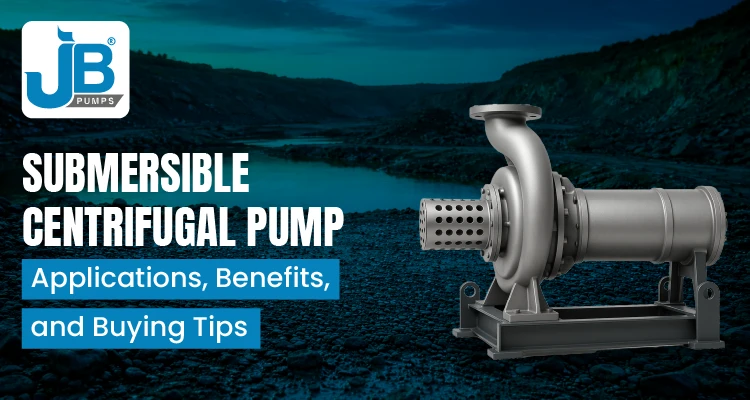
A submersible centrifugal pump is a specialized device featuring a hermetically sealed motor close-coupled to the pump body. The entire assembly is designed to be submerged in the fluid it is pumping.
The Engineering Behind the Power
The magic is wrapped in the seal. The motor is protected from the surrounding liquid by a high-quality mechanical seal system (often utilizing oil-filled chambers). This prevents short circuits while allowing the surrounding fluid to naturally cool the motor, enabling continuous operation even under heavy loads.
How It Works (Step-by-Step)
For those asking, “How do submersible centrifugal pumps work?”, here is the simplified process:
- Intake: Fluid enters the pump through the suction inlet (usually at the bottom).
- Acceleration: The electric motor spins an impeller at high speeds.
- Kinetic Energy: The spinning impeller creates centrifugal force, flinging the fluid outward from the center of rotation.
- Pressure Build-Up: As fluid moves through the diffuser (or volute), its velocity is converted into pressure energy.
- Discharge: The pressurized fluid is forced through the discharge pipe to the surface.
Because these pumps push fluid rather than pull it, they are significantly more efficient for deep applications than jet pumps or suction-lift pumps.
Industrial Applications: Where Are These Pumps Used?
The versatility of the industrial submersible centrifugal pump is unmatched. Depending on the impeller design and material, they can handle clear water, viscous oils, or abrasive slurries.
1. Wastewater and Sewage Treatment
Handling human waste and industrial effluent is tough. Submersible Sewage Pumps are equipped with non-clog or vortex impellers designed to pass solids without jamming.
- Use Cases: Municipal lift stations, Effluent Treatment Plants (ETP), and residential septic systems.
- Why Submersible? It eliminates the need for a separate pump house, reducing infrastructure costs.
2. Construction and Site Dewatering
Construction sites in India often face groundwater ingress or monsoon flooding. Submersible Dewatering Pumps are portable and powerful.
- Use Cases: Drying out foundation pits, trenches, tunnels, and basements.
- Why Submersible? They can be dropped directly into a flooded pit and run immediately without priming.
3. Mining and Mineral Processing
This is one of the harshest environments for machinery. Submersible Slurry Pumps and Submersible Sludge Pumps are built with high-chrome alloys to resist wear.
- Use Cases: Transporting abrasive mud, coal washing, ore transport, and managing mine tailings.
- Why Submersible? They can handle high concentrations of solids that would destroy a standard water pump.
4. Agriculture and Irrigation
For farmers, water access determines the harvest.
- Use Cases: Deep borewells, river intake systems, and large-scale drip irrigation.
- Why Submersible? They provide consistent pressure and are theft resistant as they are hidden underground.
5. Oil, Gas, and Chemical Processing
In these sectors, pumps often move hazardous or corrosive fluids.
- Use Cases: Offshore drilling rig supply, chemical transfer, and refinery drainage.
- Why Submersible? Explosion-proof variants ensure safety in volatile environments.
Top Benefits of Centrifugal Submersible Pumps
Why should a project manager choose a submersible unit over a vertical turbine or split-case pump?
1. No Priming Required (Self-Priming)
This is the biggest advantage. Since the pump is already underwater, there is no air in the suction line. You save time and eliminate the cost of vacuum priming systems.
2. Enhanced Energy Efficiency
A surface pump spends a lot of energy fighting gravity and friction to suck water up the intake pipe. A submersible pump uses positive pressure from the surrounding fluid to help move the liquid, resulting in lower power consumption (electricity bills).
3. Cavitation Resistance
Cavitation occurs when vapor bubbles form and collapse, pitting the metal impeller. Because submersible pumps operate deep underwater with high intake pressure, the risk of cavitation is virtually zero.
4. Silent Operation
If your site is near a residential zone, noise pollution is a concern. The water surrounding the pump acts as a natural sound barrier, making these units whisper-quiet compared to roaring diesel surface pumps.
5. Versatile Solids Handling
From a Self-Priming Mud Pump to a heavy-duty slurry unit, these pumps can be customized to chop, grind, or pass solids, making them ideal for “dirty” jobs.
Detailed Buying Guide: How to Choose the Right Pump
Searching for a “buy submersible centrifugal pump” option? Don’t just look at the price tag. Improper sizing is the #1 cause of pump failure.
Use this 5-step checklist from the experts at JB Pumps:
Step 1: Define the Fluid Characteristics
- Clean Water: Standard Cast Iron pump.
- Corrosive Chemicals: Stainless Steel (SS 304/316).
- Abrasive Slurry: High Chrome or Hardened Iron.
- Solids: Does the fluid contain rags or rocks? You need a Submersible Sewage Pump with a large free passage.
Step 2: Calculate Flow and Head
- Flow Rate (Q): How much volume do you need per hour? (e.g., 50 m³/hr).
- Total Dynamic Head (H): This is the vertical distance from the water level to the discharge point, plus the friction loss in the pipe.
- Warning: Buying a pump with too much head pressure can actually damage the motor due to excessive flow (runout).
Step 3: Check the Impeller Type
- Closed Impeller: Best for clean water and high efficiency.
- Semi-Open Impeller: Good for liquids with small amounts of sand.
- Vortex Impeller: Best for sewage and hard materials (minimize clogging).
- Cutter/Grinder: Necessary if the fluid contains long fabrics or heavy waste.
Step 4: Temperature & Depth Limits
Standard submersible motors can handle water up to 40°C. If you are pumping hot industrial wastewater, you need a specialized high-temperature motor. Also, check the maximum submersion depth – going too deep can crush the seals.
Step 5: Automation & Protection
Does the pump come with a control panel? Look for:
- Dry Run Protection: Stops the pump if water runs out.
- Overload Protection: Prevents motor burnout during voltage spikes.
- Moisture Sensors: Detects if a seal has failed before the motor is damaged.
Installation and Maintenance Best Practices
Even the best submersible centrifugal pump requires care. Follow these tips to extend the lifespan of your equipment.
Installation Tips
- Don’t lift by the cable: Never use the power cable to lower the pump. Use a stainless steel lifting chain or rope.
- Vertical Alignment: Ensure the pump hangs vertically. Operating at a low angle can wear out the bearings unevenly.
- Check Valve: Always install a non-return valve on the discharge line to prevent backflow water hammer when the pump stops.
Maintenance Schedule
- Quarterly: Check the resistance of the motor insulation.
- Every 6 Months: Check the oil in the seal chamber. Milky oil indicates water ingress (seal failure).
- Annually: Inspect the impeller for wear and tear, especially if pumping slurry.
Conclusion: Choosing the Best Pump for Your Industry
Whether you are looking for an industrial submersible pump supplier for a mining project or a dewatering solution for construction, the Submersible Centrifugal Pump is a versatile, efficient, and reputable choice. It solves the headache of priming, saves on energy bills, and operates silently.
However, the “best” pump is only as good as its fit for your specific application.
At JB Pumps, we don’t just sell pumps; we provide engineered solutions. From heavy-duty slurry pumps to precision rental pumps, our catalog is designed to meet the rigorous demands of Indian and international industries.
Stop worrying about fluid management and start pumping efficiently.
Ready to find your solution?
- Download Our Catalogue
- Get a custom quote: Contact JB Pumps
FAQ: Common Questions on Submersible Pumps
1. Can a submersible centrifugal pump run dry?
No. Most models rely on the surrounding fluid to cool the motor. Running dry for even a few minutes can melt the mechanical seals and burn the windings. Always use a float switch or level controller.
2. What is the difference between a slurry pump and a sludge pump?
A slurry pump is designed for abrasive, hard solids (like sand/ore) and usually runs at lower speeds to reduce wear. A sludge pump handles softer, thicker materials (like biological waste) and focuses on non-clogging capabilities.
3. How do I know if my pump is cavitating?
Since it is underwater, you can’t hear it easily. However, signs include a sudden drop-in flow rate, high vibration in the discharge pipe, or fluctuating amperage readings on the control panel.
4. Can I use a submersible pump for hot water?
Standard models are rated for up to 40-50°C. For industrial boiler blowdown or hot chemical transfer (up to 90°C), you need a specialized high-temp submersible pump from manufacturers like JB Pumps.
5. How often should I replace the mechanical seal?
It depends on the usage. In clean water, seals can last 2-3 years. In abrasive slurry applications, they may need checking every 6-12 months.